可突增性能实例是唯一将积分用于 CPU 使用的实例类型。可突增性能实例(包括 T3、T3a 和 T2 实例)旨在提供基准水平的 CPU 性能,并且能够在您的工作负载需要时突增到更高的水平。可突增性能实例非常适合用于各种通用应用程序。包括微服务、低延迟交互式应用程序、中小型数据库、虚拟桌面、开发、构建和暂存环境、代码存储库以及产品原型。
CPU 积分和基准性能
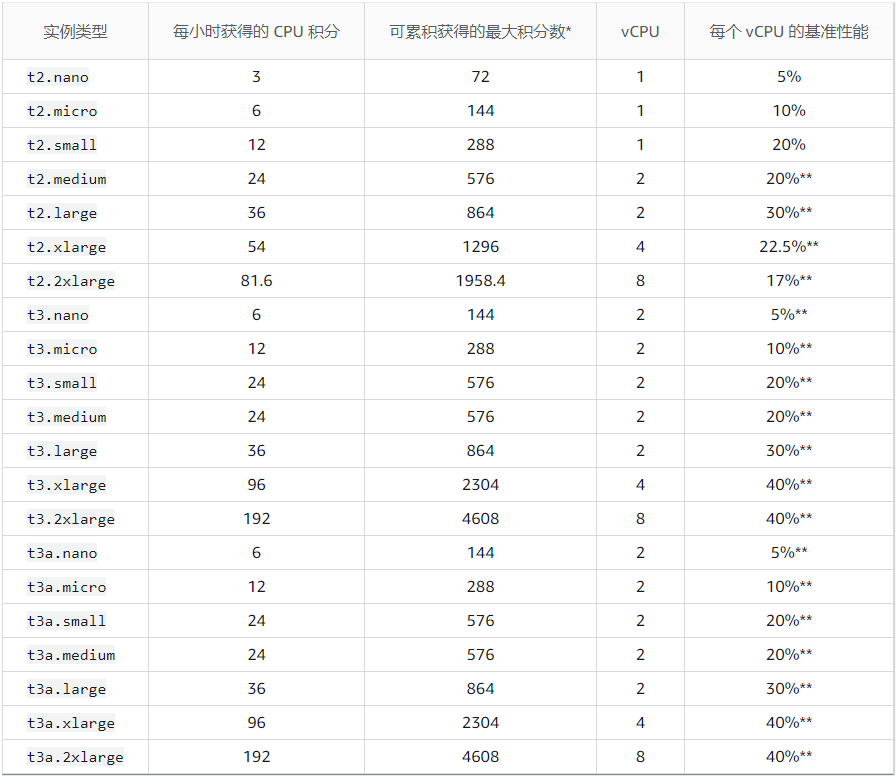
传统 Amazon EC2 实例类型提供固定的性能,而可突增性能实例提供基准水平的 CPU 性能并能够突增到基准水平之上。如果你的实例CPU负载超过了基准性能,此时就会使用CPU积分,每个积分允许你一个vCPU利用率达到100%,运行一分钟;如果你的实例CPU少于基准性能(例如,处于空闲状态时),每小时也会获得一定积分,当然每个可突增实例的CPU积分累计也是有上限的,详见下面的表格。
何时使用无限模式与固定 CPU
下图显示了可突增性能实例t3.large 花费与固定性能实例m5.large 花费相同的收支平衡 CPU 使用率点。t3.large 的收支平衡 CPU 使用率点为 42.5%。
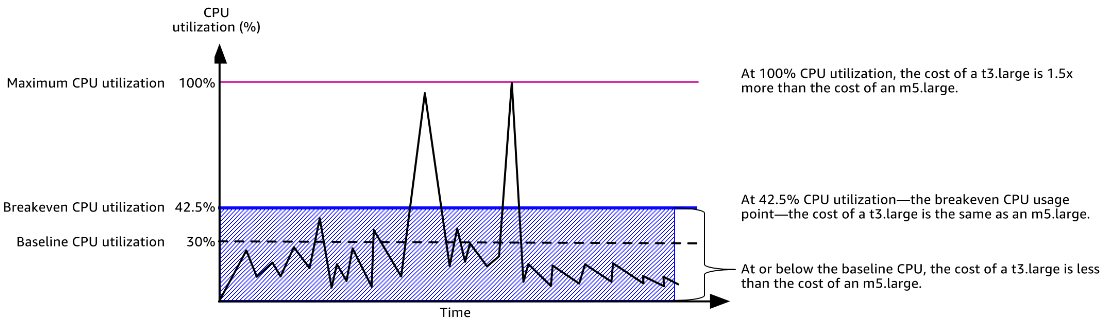
如果平均 CPU 使用率为 42.5%,则运行 t3.large 的费用与 m5.large 的运行费用相同,如果平均 CPU 使用率高于 42.5%,则t3.large费用更高。
如果工作负载需要低于 42.5% 的平均 CPU 使用率,您可以受益于 t3.large 的较低价格,同时获得与 m5.large 相同的性能。
Burstable performance instances are the only instance types that use credits for CPU usage. Burstable performance instances (including T3, T3a, and T2 instances) are designed to provide a baseline level of CPU performance and the ability to burst to higher levels when your workload requires it. Burstable performance instances are well-suited for a variety of general-purpose applications. These include microservices, low-latency interactive applications, small and medium databases, virtual desktops, development, build and staging environments, code repositories, and product prototypes.
CPU Credits and Baseline Performance
Traditional Amazon EC2 instance types provide fixed performance, while burstable performance instances provide a baseline level of CPU performance with the ability to burst above the baseline. If your instance's CPU load exceeds the baseline performance, CPU credits are used. Each credit allows you to run one vCPU at 100% utilization for one minute. If your instance's CPU is below baseline performance (for example, when idle), it also earns credits every hour. Of course, each burstable instance has a limit on accumulated CPU credits, as shown in the table below.
When to Use Unlimited Mode vs. Fixed CPU
The figure below shows the break-even CPU utilization point where the cost of burstable performance instance t3.large equals the cost of fixed performance instance m5.large. The break-even CPU utilization point for t3.large is 42.5%.
If the average CPU utilization is 42.5%, running t3.large costs the same as running m5.large. If the average CPU utilization is above 42.5%, t3.large costs more.
If your workload requires less than 42.5% average CPU utilization, you can benefit from the lower price of t3.large while getting the same performance as m5.large.